
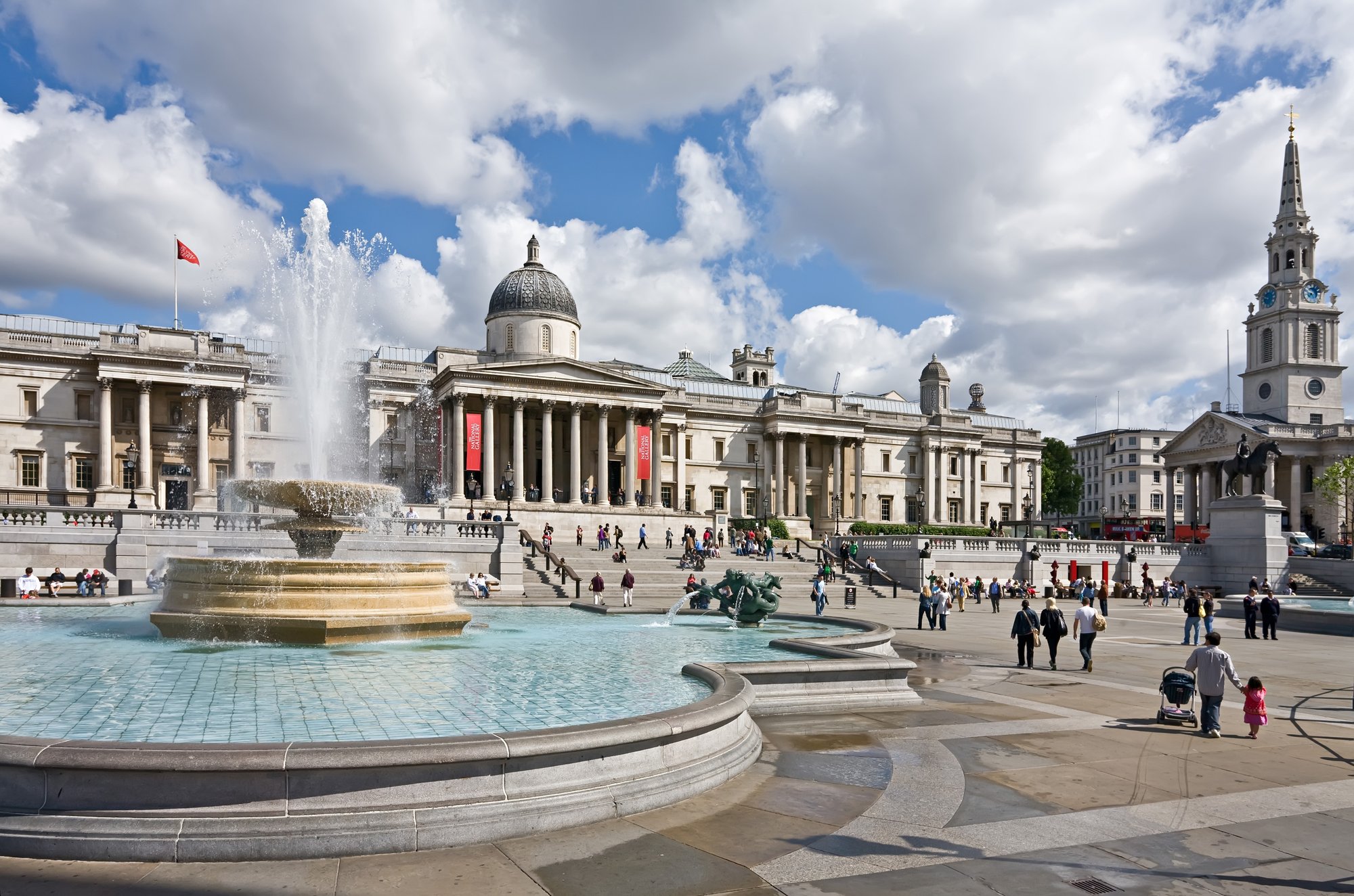
Trafalgar Square
- piazza
- Price: Free
- Opening hours: Open 24 hours
History
Trafalgar Square was laid out between the 1830s and 1840s on the site of the old royal stables, and from the outset it was conceived as a monument to British naval power: a public space commemorating Admiral Horatio Nelson's decisive victory over the combined French and Spanish fleets at the Battle of Trafalgar in 1805. Nelson himself did not survive the battle, struck down as the fighting turned in Britain's favour, which lends his 52-metre granite column at the square's centre — completed in 1843, with Nelson's statue gazing down Whitehall toward the Houses of Parliament — an added note of sacrifice behind the triumph.
Four monumental bronze lions were added at the column's base in 1867, designed by the animal painter Sir Edwin Landseer, who studied a real lion's carcass from London Zoo to get the anatomy right — though the beast reportedly decomposed faster than he could finish sketching it, which is why, according to long-standing art-historical gossip, the lions' paws look distinctly more house-cat than king-of-the-jungle. On the square's northern side, the National Gallery has presided since 1838 over one of Europe's finest collections of Western painting, cementing Trafalgar Square's role as both a historic monument and one of London's great cultural crossroads.
Did you know?
One corner of the square holds a quirk most visitors never expect: the north-west plinth was built in 1841 to carry an equestrian statue of William IV, but funds ran out and it stood empty for more than 150 years. Since 1999 it has instead hosted the Fourth Plinth programme, a rotating series of contemporary art commissions that has put everything from a giant blue cockerel to a boy on a rocking horse in one of the most conventionally Victorian settings in London — a deliberately modern jolt inside a thoroughly historic square.
Trafalgar Square has also long served as London's default gathering place for major public moments, from wartime celebrations and royal jubilees to protests and the New Year's Eve crowds counting down beneath Nelson's Column. Its fountains, part of the original design and enlarged in 1939, are popularly said to have been included partly to leave less open space for large political rallies — a piece of Victorian and early-20th-century crowd-control thinking that has done little to stop the square becoming exactly that ever since.
Good to know
Trafalgar Square is free to visit and open around the clock, making it an easy stop to combine with a walk down Whitehall to Parliament, a visit to the National Gallery or the National Portrait Gallery right on its doorstep, or a stroll down The Mall toward Buckingham Palace — it sits at a genuine crossroads between the West End, Whitehall and the river.
Because it is London's default venue for major public events, from national celebrations to protests and the New Year's Eve countdown, the square can become extremely crowded and partially closed off at short notice. If visiting on a date close to a known event, it's worth checking ahead and allowing extra time, or picking a quieter early-morning slot to see the column and lions without the crowds.