
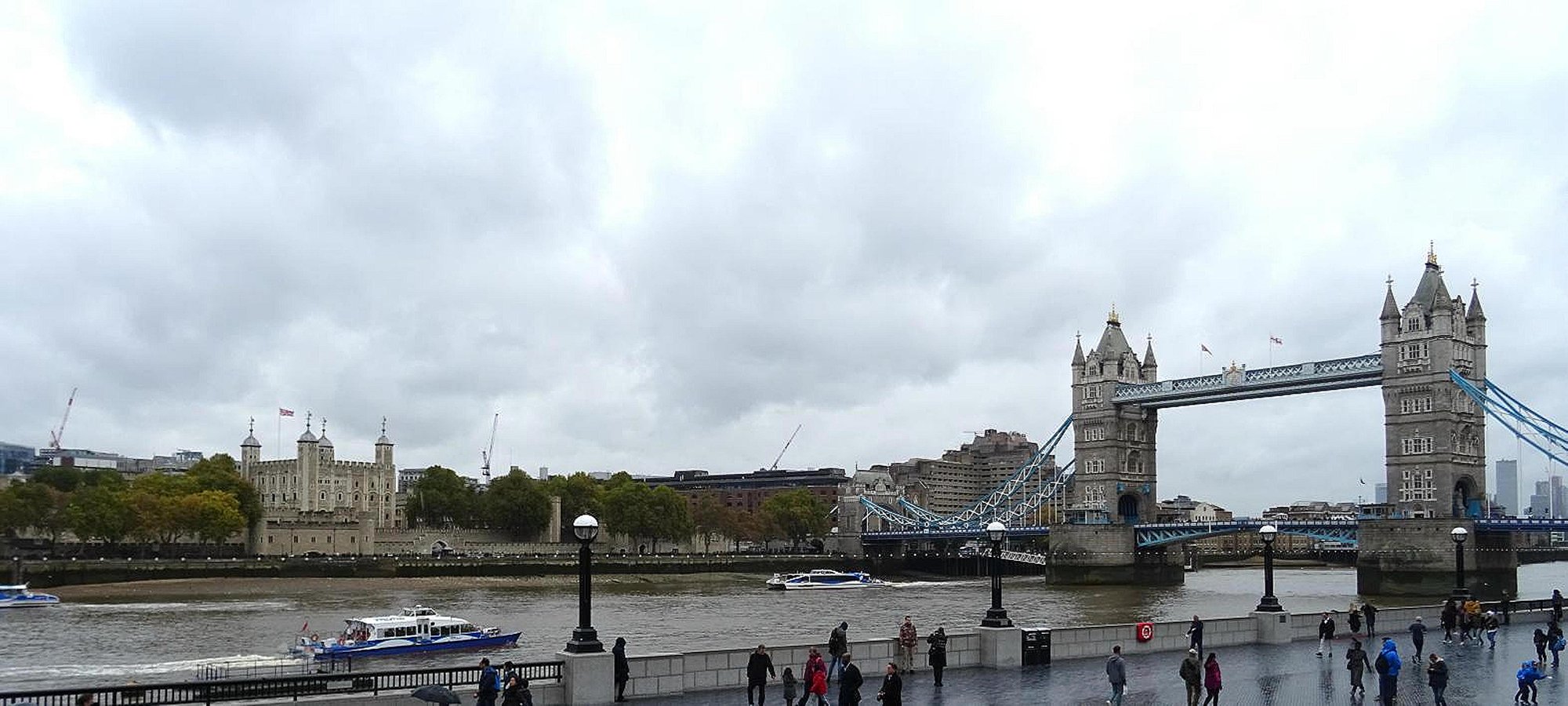
Tower Bridge
- bridge
- viewpoint
- Price: £13.50 - £17
- Opening hours: 09:30-18:00 daily
History
A design competition opened in 1877 to solve a genuine problem: the rapidly growing docks of the East End needed a new river crossing, but London Bridge, the nearest one, was already overwhelmed with traffic, and any new bridge close to the Tower of London had to let tall-masted ships continue upstream to the Pool of London. More than 50 entries were submitted, including one from Sir Joseph Bazalgette, already famous for engineering London's sewer network, before the competition stalled and was effectively restarted with architect Sir Horace Jones and engineer Sir John Wolfe Barry, whose bascule-bridge design won approval from Parliament in 1884.
Construction began in 1886. Jones died just a year in and never saw the bridge finished; it was completed under Wolfe Barry and opened on 30 June 1894 in a ceremony led by the Prince and Princess of Wales. The design paired a suspension bridge with a central bascule mechanism, wrapped in Victorian Gothic stone towers deliberately styled to sit comfortably beside its much older neighbour, the Tower of London.
Did you know?
The high-level walkways, 42 metres above the water, were part of the original 1894 design, meant to let pedestrians keep crossing while the bascules were raised below. Londoners largely preferred to just wait for the bridge to close again, though, and the walkways developed a seedier reputation as a haunt for pickpockets and prostitutes, prompting the City to shut them to the public in 1910. They reopened only in 1982, as a paid exhibition, and the glass floor panels that now let visitors look straight down at the traffic and the river beneath their feet were added as recently as 2014.
The bascules were originally raised by steam-driven hydraulic pumps, housed in engine rooms at the southern end of the bridge that still preserve the original Victorian boilers and machinery as a working museum display; an electro-hydraulic system replaced steam power in the 1970s, though the basic mechanism is unchanged. The bridge still lifts several times a week for tall vessels, with each lift published in advance online, drawing onlookers to the riverbanks to watch the roadway split open.
Good to know
Tower Bridge, with its paired Gothic towers, is routinely confused with the plain, tower-less crossing just a few hundred metres upstream that is actually called London Bridge — a mix-up so persistent it spawned an urban legend that when the 1830s London Bridge was sold to an American businessman in 1968 and shipped to Lake Havasu City, Arizona, he believed he was buying the famous Tower Bridge instead. The buyer always denied it, but the story is still told today.
Check the bridge-lift schedule online before visiting if seeing the bascules rise for a passing ship is part of the appeal — it happens several times a week but not on a fixed daily timetable. Given the short walk between them, it's easy to combine a visit with the Tower of London right next door.