
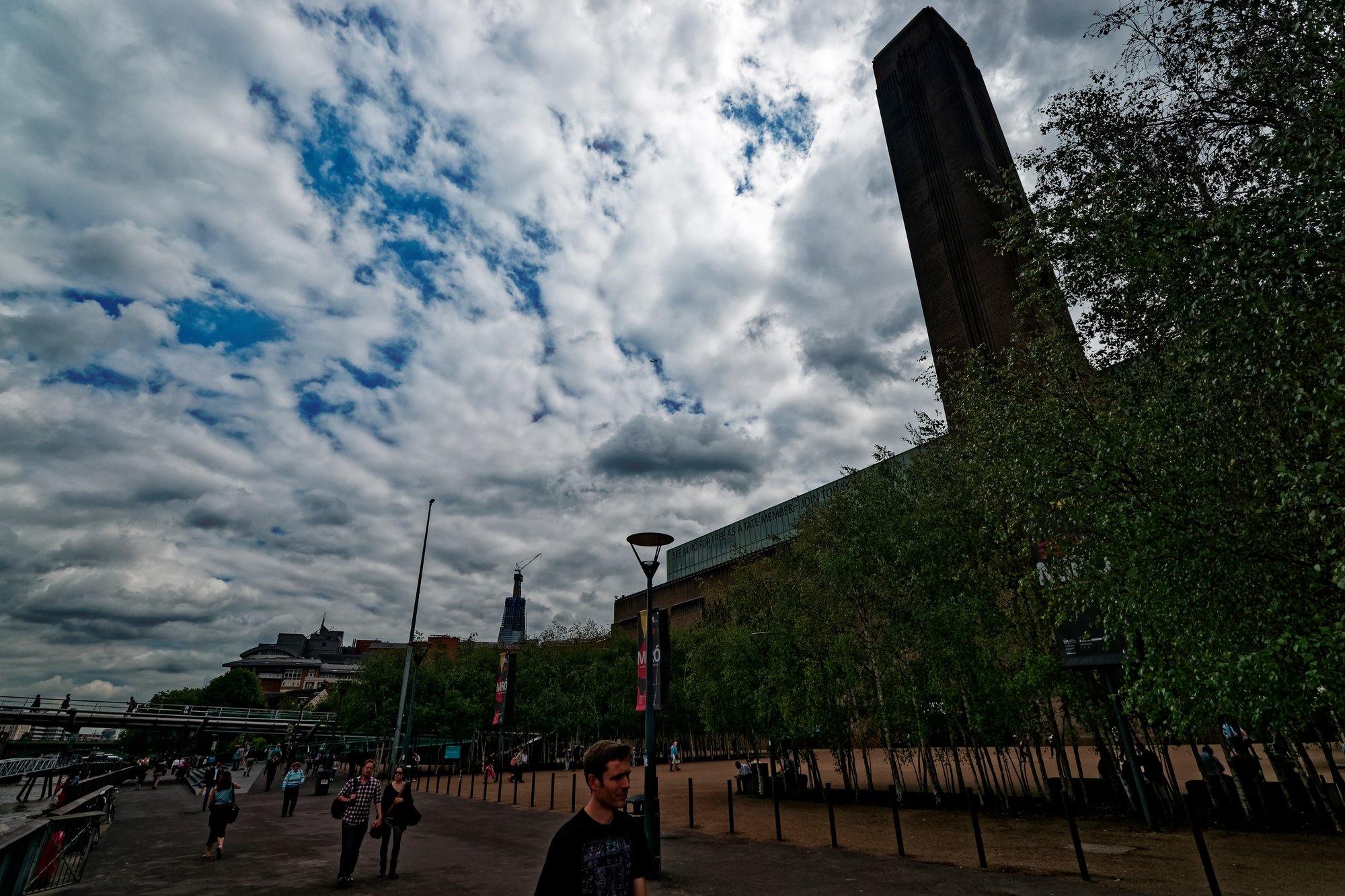
Tate Modern
- art-museum
- design
- Price: Free (charge for special exhibitions)
- Opening hours: 10:00-18:00 daily
History
Tate Modern occupies the former Bankside Power Station, a brick cathedral of industry designed in the 1940s and 50s by Sir Giles Gilbert Scott — an architect with an unusually broad range, also responsible for the red telephone box and, on the opposite bank of the Thames, Battersea Power Station. When Bankside was proposed, there were fears it would overwhelm the view of St Paul's Cathedral facing it across the river, so Scott redesigned it with a single central chimney rather than the two originally planned, and kept its height just below the dome — a compromise still visible today if you compare the two skylines.
The station was decommissioned in 1981 and stood empty for nearly two decades before being chosen, out of more than 70 competition entries, for conversion into a national gallery of modern art by the Swiss architects Herzog & de Meuron, who deliberately kept much of its raw industrial character — exposed brick, steel and the single chimney — rather than disguising it. It opened as Tate Modern in 2000, part of a wave of Millennium-era projects that transformed London's South Bank, and a pyramidal extension, the Blavatnik Building, added further galleries and a free public viewing platform in 2016.
Did you know?
Rather than arranging its collection by chronology or national school, as most encyclopaedic museums do, Tate Modern groups its Rothkos, Warhols and Louise Bourgeois sculptures — alongside international contemporary work — around broad themes, deliberately inviting visitors to notice echoes between a 1920s Surrealist canvas and a work made last year rather than following a single linear story of art history.
The Turbine Hall, the building's cavernous five-storey former machine room, is handed each year to a single artist commissioned to fill it on a scale impossible almost anywhere else. Olafur Eliasson's The Weather Project in 2003 hung an enormous artificial sun in mist at the far end and drew crowds who simply lay on the floor looking up at it; Ai Weiwei's Sunflower Seeds in 2010 covered the floor with what looked like a hundred million husks, each one individually hand-sculpted and hand-painted in porcelain by artisans in Jingdezhen, China.
Good to know
Entry to the permanent collection is free, in keeping with the policy across all four Tate galleries in Britain; only temporary, ticketed exhibitions carry a charge, and popular ones are worth booking online in advance rather than risking a sold-out slot on the day.
The Blavatnik Building's tenth-floor viewing platform is also free and gives one of the best skyline panoramas in London, St Paul's dome included, without the cost of a dedicated paid viewpoint elsewhere in the city. The gallery sits right on the Thames Path, linked to St Paul's on the opposite bank by the Millennium Bridge, making the two easy to combine in a single afternoon.