
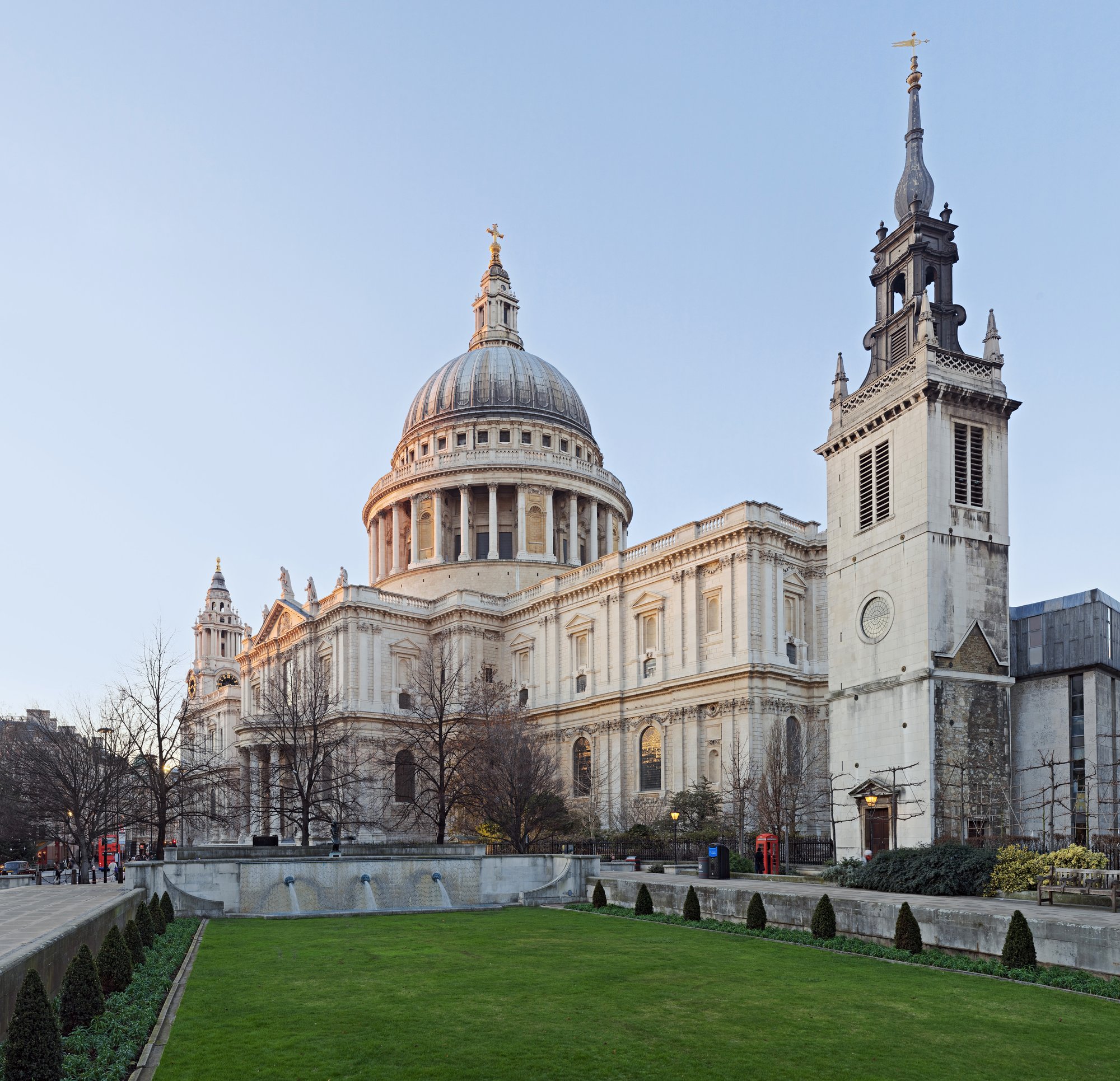
St Paul's Cathedral
- sacred
- viewpoint
- Price: £25 - £30
- Opening hours: 08:30-16:30 Mon-Sat (closed Sun to visitors)
History
Old St Paul's, the medieval cathedral that had stood on this site since Anglo-Saxon times, burned down in the Great Fire of London in 1666, clearing the ground for Christopher Wren's replacement. His first proposal, the so-called Great Model of 1673, imagined a centrally planned church on a Greek-cross layout crowned by a dome — a design so radical, and so redolent of Catholic Europe to the cathedral's clergy, that they rejected it outright for lacking the long processional nave an Anglican service required. A wooden scale model of that abandoned scheme still survives inside the cathedral today.
The compromise that followed, the Warrant Design of 1675, gave Wren a more conventional Latin-cross plan and a smaller dome, approved by Charles II — but also, crucially, royal permission to make changes as the work progressed. Wren used that clause liberally over the following three decades, steering the building back toward his own Baroque vision, dome included, and lived to see it completed in 1710, a rare case of a single architect finishing a cathedral within his own lifetime.
Wren's Dome
What looks like a single dome from the nave floor is really three structures nested inside one another. An inner brick dome, visible from below, is what worshippers actually see; hidden above it is a load-bearing brick cone that carries the real weight of the stone lantern and the golden ball and cross at the very top; and outside both sits the lead-clad timber outer dome, shaped purely for silhouette rather than structural need, that gives St Paul's its familiar profile against the sky. When it was completed, it was the second-largest cathedral dome in the world, after St Peter's in Rome.
Partway up, 257 steps from the cathedral floor, the Whispering Gallery runs around the inside of the dome, named for the trick of its curved wall: a word whispered against the stone travels around the surface in a series of grazing reflections rather than fading into open air, so it arrives clearly audible to someone standing more than 30 metres away on the opposite side. Further climbs — 376 steps in total to the Stone Gallery, 528 to the Golden Gallery at the very top — trade the acoustics for increasingly wide panoramas over the City and the Thames.
Did you know?
The cathedral's most famous image dates from the night of 29 December 1940, when photographer Herbert Mason, shooting from a nearby rooftop, captured Wren's dome standing intact and luminous above the smoke of a Luftwaffe firebombing raid. Published the next morning as "St Paul's Survives," it became one of the defining images of the Blitz. The building's survival was no accident: a volunteer team of fire-watchers known as St Paul's Watch was stationed on its roofs throughout the war specifically to spot and smother incendiary bombs before they could take hold.
Wren himself was the first person buried in the crypt below, and his epitaph, composed by his son, is written in Latin on a plain black slab: Lector, si monumentum requiris, circumspice — "Reader, if you seek his monument, look around you," meaning the cathedral itself. He shares the crypt with two of Britain's most celebrated military figures, Admiral Horatio Nelson and the Duke of Wellington, both buried almost directly beneath the dome they helped make famous.
Good to know
St Paul's is a working cathedral as well as a visitor attraction, and it closes to sightseeing entirely on Sundays, when the building is reserved for worship services — plan a weekday or Saturday visit if you want to see the interior and climb the dome. Opening hours also shift around evensong and other services during the week, so it's worth checking the schedule before you go.
Climbing to the galleries is genuinely strenuous — a narrow spiral staircase all the way, with 257 steps to the Whispering Gallery alone and 528 to the very top — so pace yourself and skip it if stairs are a problem. Respectful, non-flash photography for personal use is allowed in most of the cathedral, but not in the Whispering Gallery or in chapels set aside for private prayer, and tripods, selfie sticks and filming are not permitted anywhere inside.