
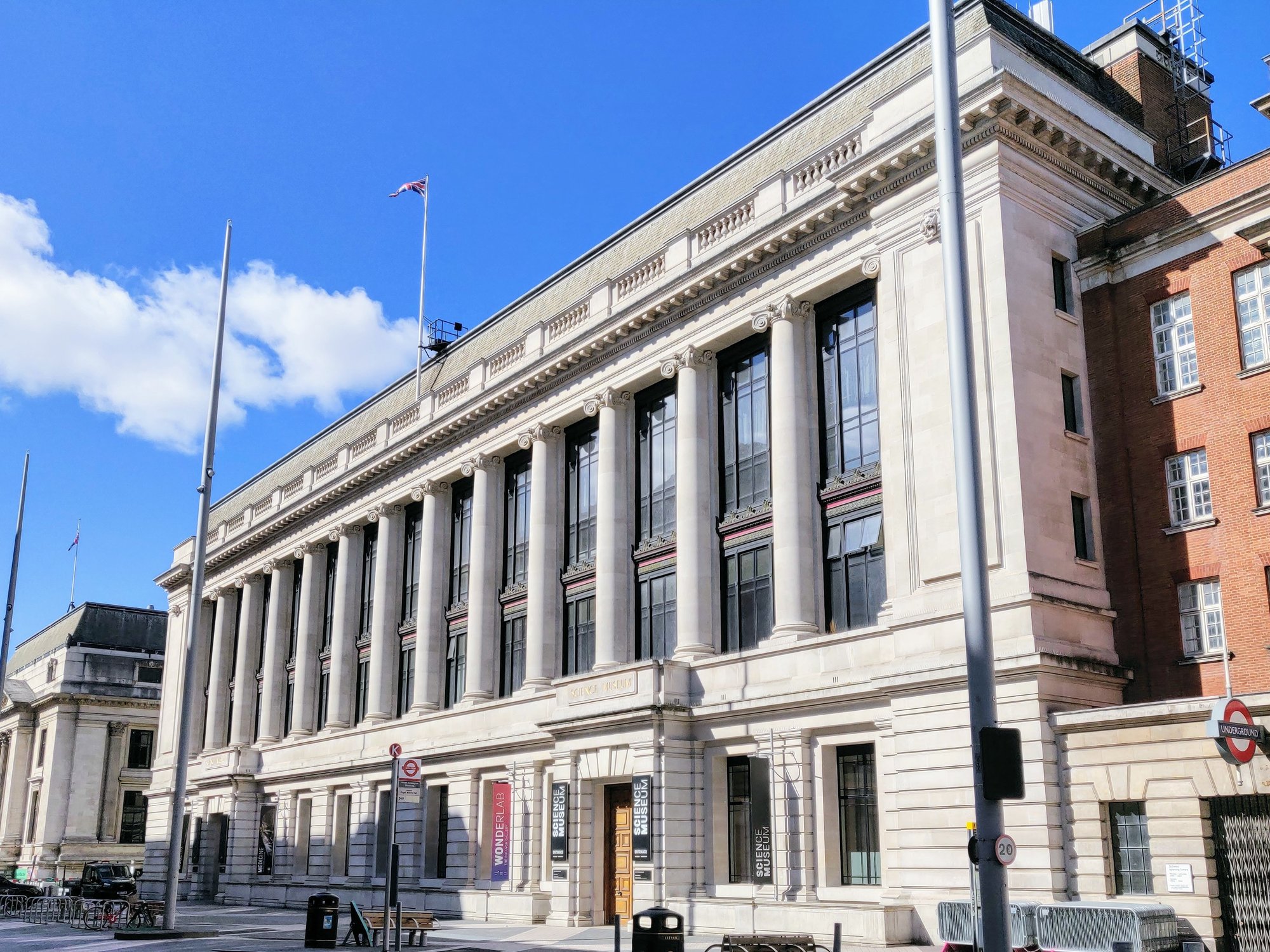
Science Museum
- museum
- family
- Price: Free (charge for special exhibitions)
- Opening hours: 10:00-18:00 daily
History
The Science Museum grew out of the leftovers of a spectacle: surplus machinery and exhibits from the Great Exhibition of 1851, the vast showcase of industry and invention staged in Hyde Park's Crystal Palace. Formally established as its own institution in 1857, the museum eventually settled into a purpose-built home on Exhibition Road, part of the South Kensington museum quarter that the Great Exhibition's profits helped create alongside the Natural History Museum and the V&A next door.
Its collection reads like a timeline of engineering itself. Stephenson's Rocket, the pioneering steam locomotive that won the Rainhill Trials in 1829 and helped define what a railway engine could be, stands not far from the actual Apollo 10 command module that carried astronauts around the Moon in May 1969, its heat shield still scorched from a real re-entry through Earth's atmosphere. Where many science museums lean on replicas, this one is stocked disproportionately with genuine artefacts, from Crick and Watson's original DNA model to early jet engines and the calculating machines of computing pioneers.
Did you know?
Apollo 10 was essentially the dress rehearsal for the Moon landing: in May 1969, its crew flew everything but the landing itself, descending to within about 15 kilometres of the lunar surface before heading home, deliberately leaving the final touchdown to Apollo 11 two months later. The scorch marks visible on the command module in the museum today are not a display effect — they're the genuine result of the capsule punching back through the atmosphere at close to 40,000 kilometres an hour.
The DNA model on display isn't a museum-made replica either. It incorporates original pieces from the metal-and-clamp model James Watson and Francis Crick built in 1953 at Cambridge to work out the double-helix structure of DNA, one of the most consequential discoveries in modern science, assembled from little more than borrowed lab parts and a lot of trial and error.
Good to know
Entry to the museum's seven floors is free, in keeping with London's South Kensington museums, though special or touring exhibitions sometimes carry their own ticket price. Wonderlab, the museum's interactive gallery of hands-on experiments and live demonstrations aimed at younger visitors, is the one exception: it requires a separate paid ticket, cheaper booked online in advance than bought on the day, with children aged three and under going free.
The museum is a firm family favourite, so weekends and school holidays bring the biggest crowds, especially around Wonderlab's timed entry slots — arriving early or booking ahead makes for a smoother visit. Its Exhibition Road location puts the Natural History Museum and the V&A within a short walk, making it easy to combine into a full day of South Kensington museum-going.