
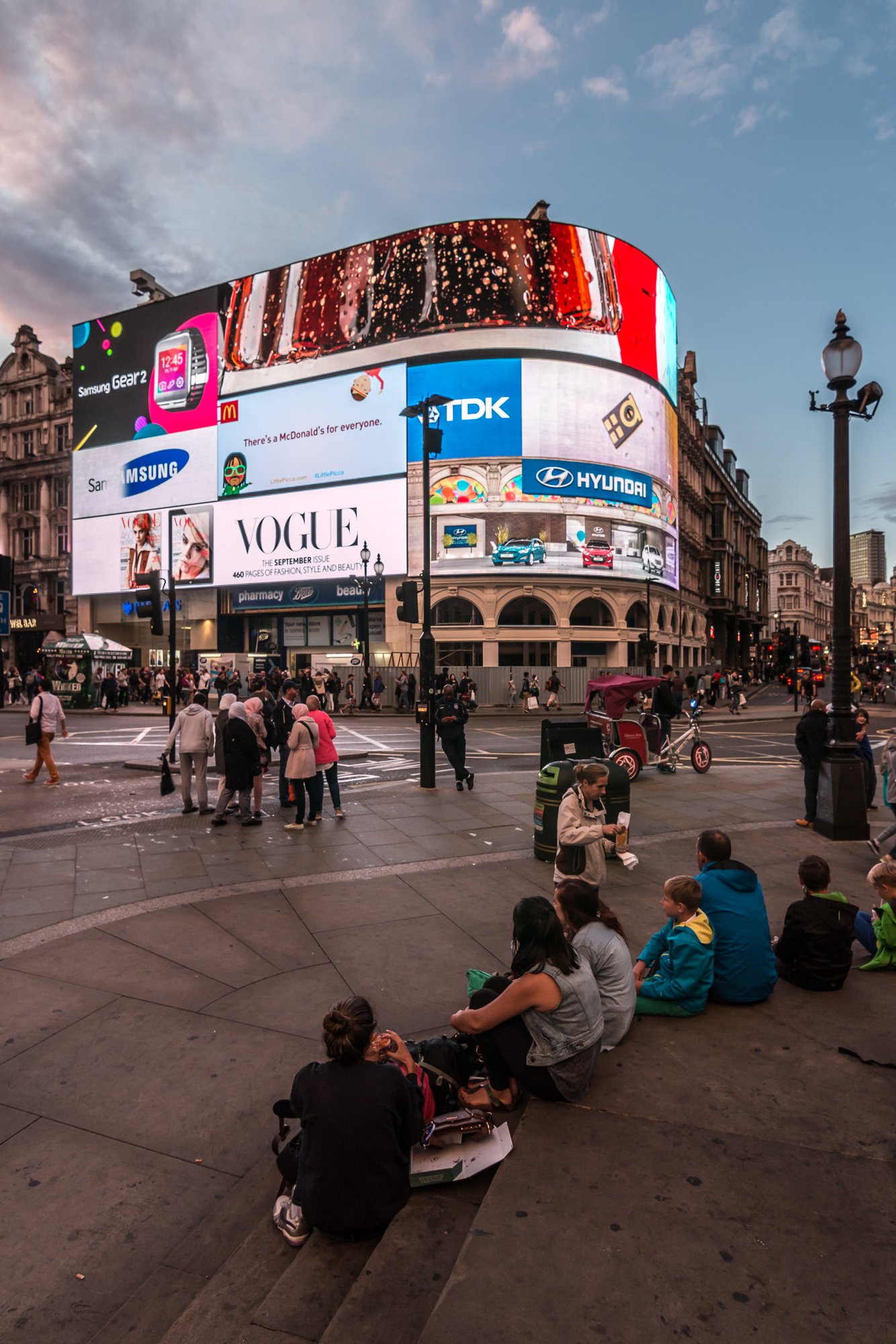
Piccadilly Circus
- piazza
- Price: Free
- Opening hours: Open 24 hours
History
Piccadilly Circus was laid out in 1819 by the architect John Nash as a circular junction connecting the newly fashionable Regent Street with Piccadilly — the "circus" in its name simply meaning a circle, from the Latin, as in a road junction rather than a travelling show. Piccadilly itself takes its name from "piccadills," the stiff ruffled collars that made a local tailor, Robert Baker, a considerable fortune in the 17th century; his grand house nearby was mockingly nicknamed Piccadilly Hall, and the name stuck to the street and eventually to Nash's junction.
The junction's trademark glow arrived in 1908, when the first illuminated advertising signs went up on the curved building at its northern corner. Over the following century they evolved from gas and electric bulbs into today's giant digital screens, having carried adverts for Guinness, Coca-Cola and countless other household names along the way — the display has become as recognisable a symbol of London as any royal landmark, and one of the most photographed advertising spots on Earth.
Did you know?
At the centre of the junction stands the Shaftesbury Memorial Fountain, unveiled in 1893 in honour of the Earl of Shaftesbury, a Victorian social reformer remembered for his campaigns to improve conditions for factory workers and child chimney sweeps. Its winged bronze-aluminium figure, sculpted by Alfred Gilbert, was one of the first large sculptures in the world cast in aluminium, then an expensive and cutting-edge material — a genuinely radical technical choice for a public monument in the 1890s.
Almost everyone calls the statue Eros, but that's a case of mistaken identity that has stuck for well over a century. Gilbert actually modelled the figure on Anteros, twin brother of Eros and god of requited love, chosen deliberately because the memorial was meant to celebrate selfless, reciprocated love and charity rather than romantic desire. The nickname Eros caught on anyway almost immediately and has simply never let go.
Good to know
Piccadilly Circus is free to visit and open around the clock, though it's at its most atmospheric after dark, when the screens are at their brightest and the steps around the fountain fill with people meeting friends before a night out. It has functioned as one of London's default meeting points for well over a century, largely because it's impossible to miss.
More than a sight in itself, the circus works as a gateway: Regent Street and its shopping lead off to the west, while the roads to the east open onto Soho, Chinatown and the cluster of historic theatres that make up London's West End. It's worth treating a visit here as the start of an evening out rather than a standalone stop.