
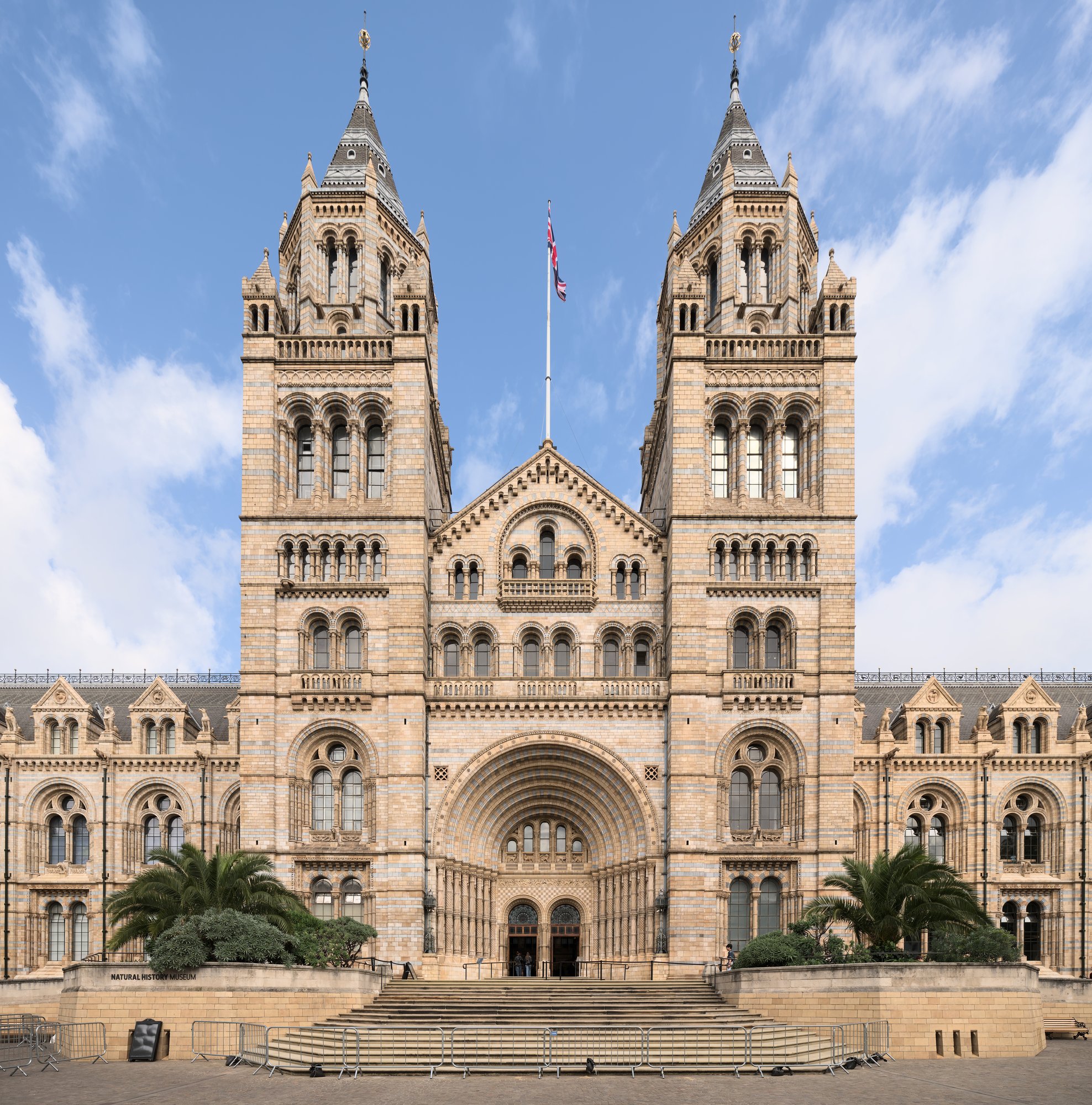
Natural History Museum
- museum
- family
- Price: Free (charge for special exhibitions)
- Opening hours: 10:00-17:50 daily
History
The Natural History Museum exists because the British Museum ran out of room. Its natural history collections — fossils, minerals, stuffed animals, botanical specimens — had grown so large by the mid-19th century that keeping them under the same roof as the antiquities and manuscripts became impractical, and the decision was made to give them a home of their own. Architect Alfred Waterhouse answered the brief with something far grander than a simple storage building: a vast Romanesque Revival palace faced in cream and blue terracotta, its walls crawling with sculpted animals, living species to the west of the main hall and extinct ones to the east. It opened to the public in 1881.
That sense of theatre continues in Hintze Hall, the cathedral-like entrance space that greets every visitor. For decades its centrepiece was a plaster cast of a Diplodocus skeleton, affectionately nicknamed Dippy, which toured museums across Britain and became one of the most recognisable dinosaurs in the country before returning to pride of place in London. In 2017 Dippy was retired from the hall and replaced by Hope, the real skeleton of a blue whale suspended overhead in a diving pose — a change that still surprises visitors who remember the museum from years past.
Did you know?
Beyond Hintze Hall, the Blue Zone houses one of the world's great dinosaur collections, pairing complete fossil skeletons with animatronic reconstructions that still make it the museum's biggest draw for younger visitors. Other galleries range across minerals and gemstones, meteorites that predate the Earth itself, and a working seismograph quietly recording real earthquakes as they happen anywhere in the world, a small detail easy to miss but genuinely connected to live science.
The museum's collection runs to roughly 80 million specimens in total, only a fraction of which is ever on public display at any one time — the rest supports ongoing scientific research behind the scenes, much as it did when the collection first outgrew the British Museum more than 150 years ago.
Good to know
Entry is free, which combined with the scale of the building and its universal appeal to children makes it one of the busiest museums in London, especially on weekends and during school holidays. Arriving right at opening or later in the afternoon tends to mean noticeably shorter queues, and booking a free timed entry slot online in advance is worth doing in peak season.
The museum sits in South Kensington, within easy walking distance of the Victoria and Albert Museum and the Science Museum, so the three can comfortably be combined into a single museum-focused day if time allows. Whatever else is on the itinerary, it's worth simply pausing in Hintze Hall for a few minutes before moving on to the galleries — the room itself is as much a highlight as anything inside it.