
British Museum
- museum
- Price: Free (donations welcome)
- Opening hours: 10:00-17:00 daily, until 20:30 Fri
History
Founded in 1753 on the collection bequeathed by physician and naturalist Sir Hans Sloane, the British Museum became the first national public museum anywhere in the world to offer free entry to every visitor — a principle enshrined in its founding Act of Parliament and still upheld today. What began as roughly 71,000 objects has grown into a collection of around eight million pieces spanning two million years of human history, with galleries arranged loosely by continent and era; only a fraction of the holdings can ever be on display at once.
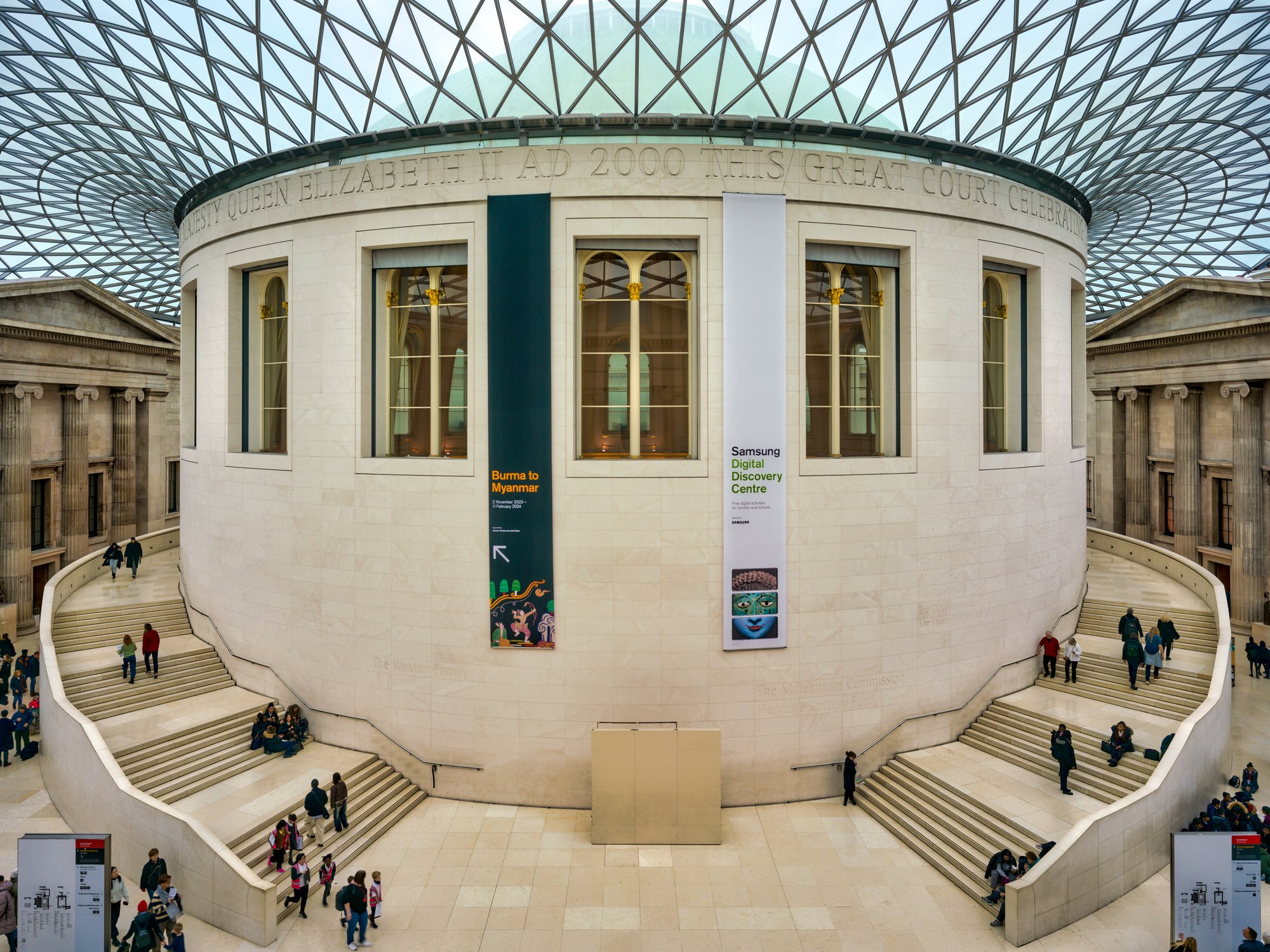
At the heart of the museum sits the Great Court, a two-acre space that had sat hidden and largely unused for over a century until architect Norman Foster enclosed it in 2000 beneath a lattice of thousands of uniquely shaped glass panes. It's now the largest covered public square in Europe, a soaring, light-filled counterpoint to the Georgian and Victorian stone galleries that ring it, built around the museum's original circular Reading Room.
Did you know?
Pride of place goes to the Rosetta Stone, a slab of inscribed granodiorite bearing the same decree in three scripts — hieroglyphic, demotic and ancient Greek. Because scholars could already read the Greek, the stone became the key that finally let them decode Egyptian hieroglyphs in the 1820s, unlocking thousands of years of Egyptian history that had until then been silent.
Almost as famous, and considerably more contested, are the Parthenon Marbles: sculpted friezes and pediment figures removed from the Acropolis in Athens in the early 1800s by Lord Elgin, then Britain's ambassador to the Ottoman Empire. Greece has long argued for their return, and the museum's continued possession of them remains a live, unresolved diplomatic and cultural dispute between the two countries.
Good to know
Entry to the permanent collection is free, as it has been since 1753, though donations are warmly encouraged and some temporary exhibitions carry a separate charge. Given the sheer scale of the place, plan on at least half a day to see the highlights properly — and if you can, split your visit into two rather than trying to cover everything in one exhausting sweep.
The museum opens daily from 10:00 to 17:00, with extended hours until 20:30 on Fridays — a good window for a quieter visit and for seeing the Great Court's glass roof catch the evening light. It sits in Bloomsbury, an easy walk from Russell Square, Holborn or Tottenham Court Road stations.