
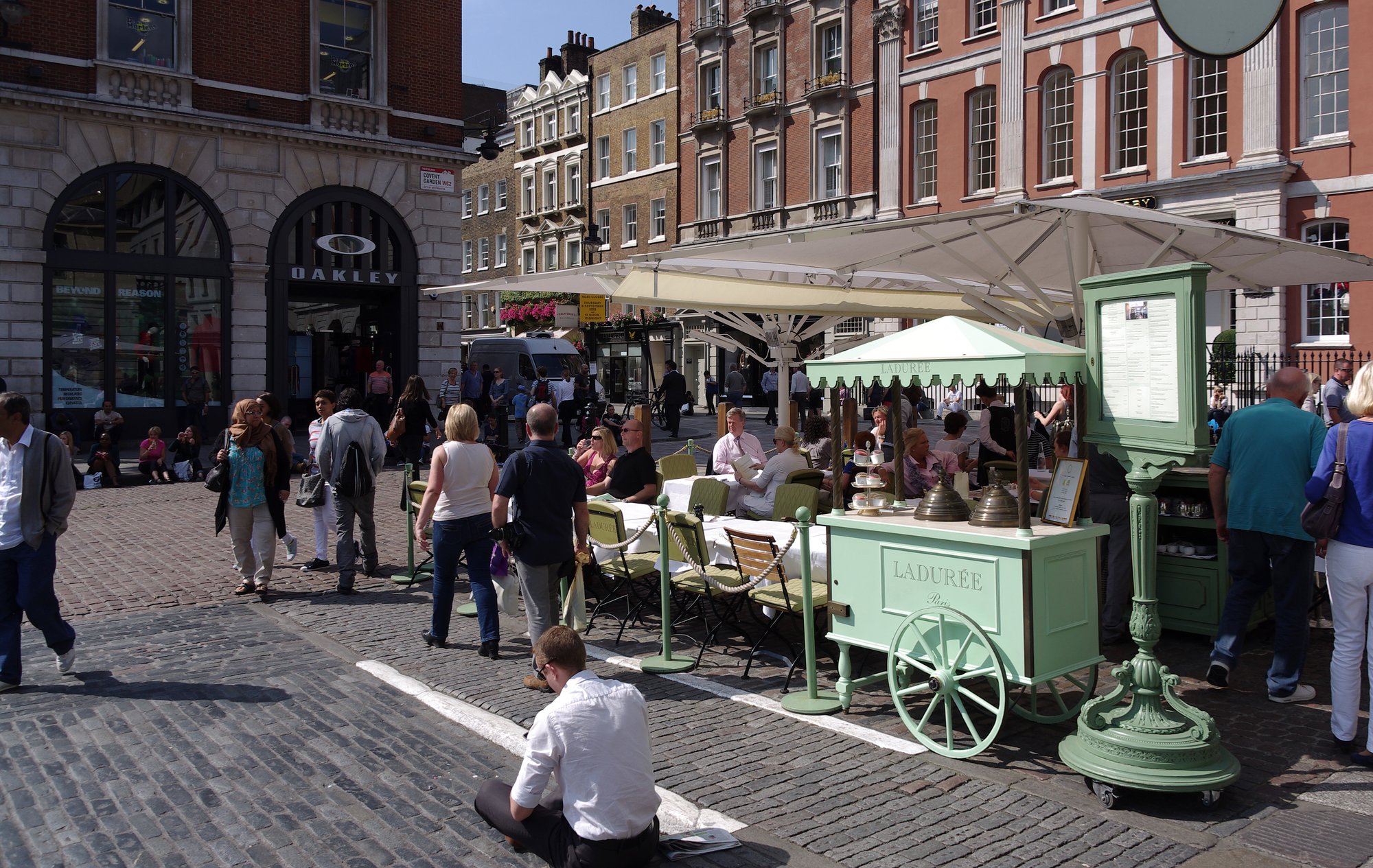
Covent Garden
- market-hall
- piazza
- Price: Free entry (shops/stalls priced individually)
- Opening hours: 10:00 - 20:00 daily (shop hours vary)
History
Inigo Jones laid out Covent Garden's piazza in the 1630s for the Earl of Bedford, giving London its first planned public square and modelling it on the Italian piazzas he had admired on his travels, with St Paul's Church anchoring its western side. The square soon evolved into the capital's principal fruit, vegetable and flower market, a boisterous trade that grew so congested and disreputable that it inspired the setting for the flower-seller Eliza Doolittle in George Bernard Shaw's Pygmalion, before the market finally outgrew the site and relocated to Nine Elms in 1974.
The handsome cast-iron and glass market hall built in the 1830s to bring some order to the chaos was saved from demolition when the market moved out, and was restored instead as a covered shopping arcade. Today it is filled with independent boutiques, cafes and stalls, while licensed street performers still entertain crowds beneath its columns much as traders once did. Just to the north, the Royal Opera House has staged opera and ballet on the same site since 1732, cementing Covent Garden's long-standing place at the heart of London's performing arts.
Did you know?
St Paul's Church, tucked behind the piazza, is known as "the Actors' Church" for its long association with the theatrical profession and its memorials to figures from Charlie Chaplin to Vivien Leigh. Its grand portico facing the square is, famously, not the real entrance at all: the Earl of Bedford wanted a plain, inexpensive building and reportedly told Jones it should be "not much better than a barn," to which Jones is said to have replied he would give him "the handsomest barn in England." Because church rules required the altar to sit at the eastern end, opposite the piazza-facing facade, the working entrance was placed round the back, in the churchyard, leaving the columned front we admire today as an elegant false door.
The street performers are not a free-for-all either: Covent Garden has run a formal licensing scheme since the 1980s, with performers auditioning for a place on the rota and booking specific pitches and time slots, making it one of the few places in the world with an organised system for street theatre.
Good to know
Browsing the piazza and market hall costs nothing, though individual shops, stalls and cafes set their own prices and hours, generally somewhere within the 10:00-20:00 window. Street performances run to a published schedule rather than happening constantly, so it's worth checking the board in the piazza or timing your visit around a specific slot if you want to be sure of catching one.
If you're drawn to the performing arts, pair a visit with the Royal Opera House next door, which offers guided backstage tours as well as evening performances. The nearest stop is Covent Garden Underground station, right by the piazza, though the walk from Leicester Square or Holborn is short and pleasant too.